
Closed vs Open Rhinoplasty: Which Approach Is Better?
The real difference between closed and open rhinoplasty — where the incisions go, what each approach makes easier, and why the surgeon's command of the technique matters more than the label.
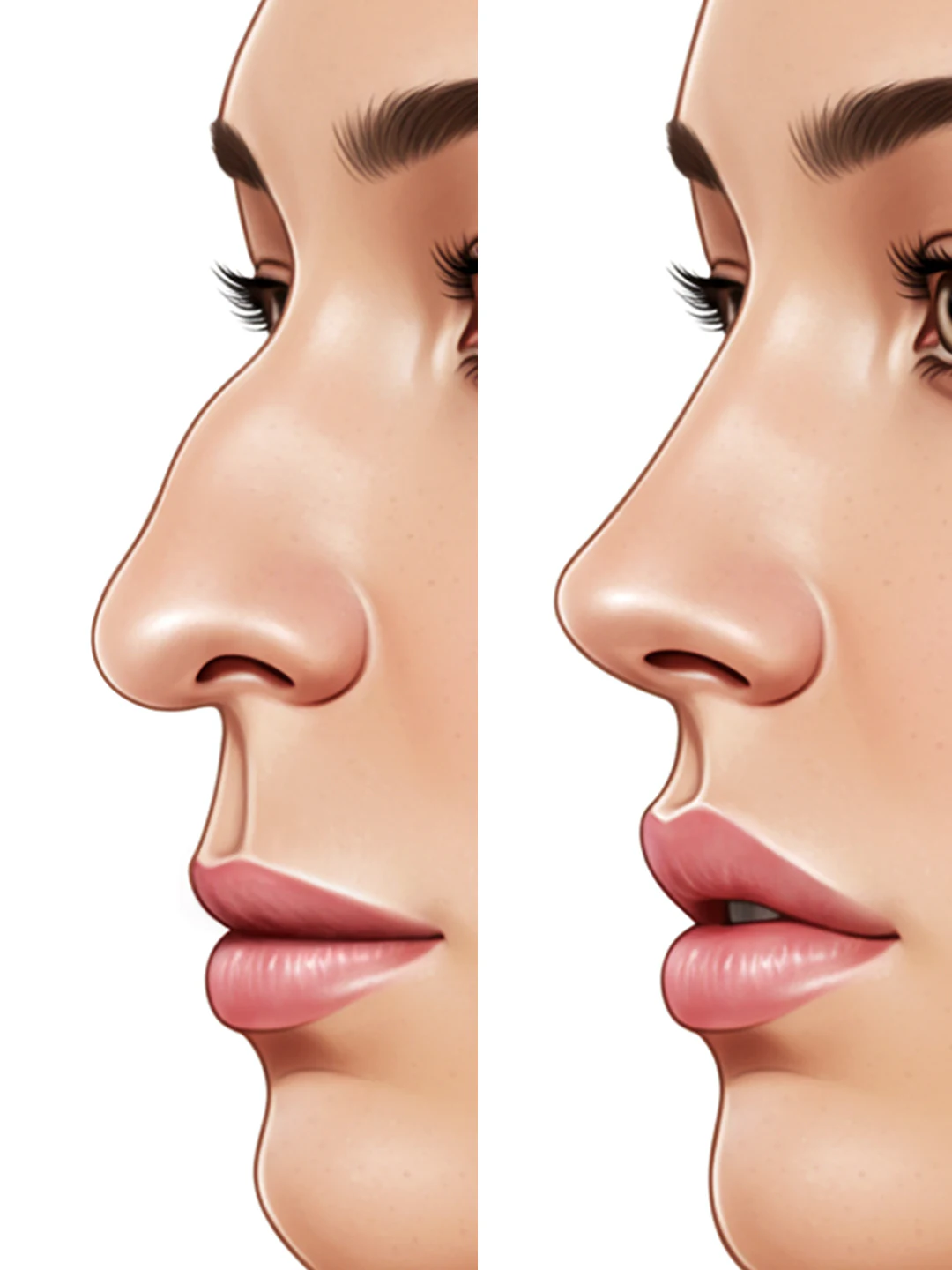
Which is better, closed or open rhinoplasty?
Neither is better in the abstract. Closed rhinoplasty places all incisions inside the nostrils and leaves no external scar, with less early swelling; open rhinoplasty adds a small columellar incision and gives the surgeon direct vision of the nasal framework, which helps in complex reconstruction. The approach should be chosen for the anatomy in front of the surgeon — and the surgeon's fluency in that approach matters far more than which label it carries.
That is the honest answer, and it is worth stating plainly because the two approaches are often marketed as though one were simply more advanced.
Approach is a means, not a goal
Where the incisions actually go
Closed (endonasal). All incisions sit inside the nostrils. The skin envelope is not fully lifted; the surgeon works through the nasal openings, often with limited direct vision, relying on tactile feedback and a very precise mental model of the anatomy underneath.
Open (external). A small incision crosses the columella and joins the internal incisions. The skin is then lifted off the framework so the cartilage and bone are directly visible.
What each approach makes easier
The closed approach preserves more of the nose's own support. Because the columella is not divided and the tip's ligamentous attachments are largely left intact, there is less disruption for the tissues to recover from. This shows up clinically as less early tip swelling, and — for the patient — no external scar and typically a quicker return to looking normal.
The open approach trades that for visibility. When the framework is severely asymmetric, when significant cartilage grafting is required, or when previous surgery has left the anatomy unpredictable, seeing the structure directly is a genuine advantage. Suturing grafts precisely into position is easier under direct vision than through a nostril.
The part that gets left out of the comparison
A closed approach is technically harder to learn. Working with restricted vision demands more operative experience and a more complete anatomical model before the first incision. That is why surgical training programmes often teach the open approach first, and why a surgeon's default approach frequently reflects their training rather than a per-patient judgement.
This is what makes "which approach is better?" the wrong question. A well-executed open rhinoplasty produces a far better result than a poorly executed closed one. The variable that predicts the outcome is the surgeon's command of the technique they are using.
The Teorhinoplasty approach
Dr. Dogan performs the majority of cases through a closed approach, combined with complete subperichondrial dissection — a plane of dissection that keeps the soft-tissue envelope and its blood supply intact over the cartilage. The aim is to change the shape while removing as little of the nose's own support as possible, which is what makes results stable over time rather than only at six months.
Where a case genuinely calls for direct vision — some revisions, some severe deviations — the open approach is used. Choosing it is a clinical decision, not a compromise.
What to ask at your consultation
- Which approach do you recommend in my case, and why that one?
- What proportion of your cases do you perform closed?
- If the plan changes during surgery, what would prompt that?
- How will you preserve nasal support while changing the shape?
Final takeaway
Closed and open rhinoplasty are tools, not tiers. Ask which one your anatomy calls for and why — and pay far more attention to how confidently your surgeon can explain that reasoning than to which approach they name.
Teorhinoplasty
Dr. Dogan's signature rhinoplasty technique -- no cast, no tampons.
Frequently Asked Questions
What is the difference between closed and open rhinoplasty?
- In closed (endonasal) rhinoplasty every incision is placed inside the nostrils, leaving no external scar. In open rhinoplasty the surgeon adds a small incision across the columella — the strip of skin between the nostrils — and lifts the skin to expose the nasal framework directly.
Does open rhinoplasty leave a visible scar?
- It leaves a scar on the columella that typically heals to a fine line and is difficult to see at conversational distance. It is a real scar, not an invisible one, but for most patients it is not a significant cosmetic concern.
Is closed rhinoplasty less swollen than open rhinoplasty?
- Generally yes in the early weeks. The closed approach does not divide the columella or lift the full skin envelope, so there is less disruption to lymphatic drainage and tip swelling tends to settle sooner. By 12 months the difference between the two is much smaller.
Which approach is used for revision rhinoplasty?
- Revision cases more often use the open approach, because scarred and distorted anatomy is easier to assess and reconstruct under direct vision. Some revisions can still be done closed — it depends on what needs rebuilding, not on a fixed rule.
How do I choose between the two?
- You do not choose the approach; you choose the surgeon. The right approach follows from your anatomy and what needs to change. A surgeon who performs one approach for every patient is fitting the patient to the technique rather than the other way round.