
Facelift vs Midface Lift: Which One Do I Actually Need?
The midface lift and the full facelift treat different parts of the face and different stages of ageing. How to tell which applies to you — and when the answer is both.
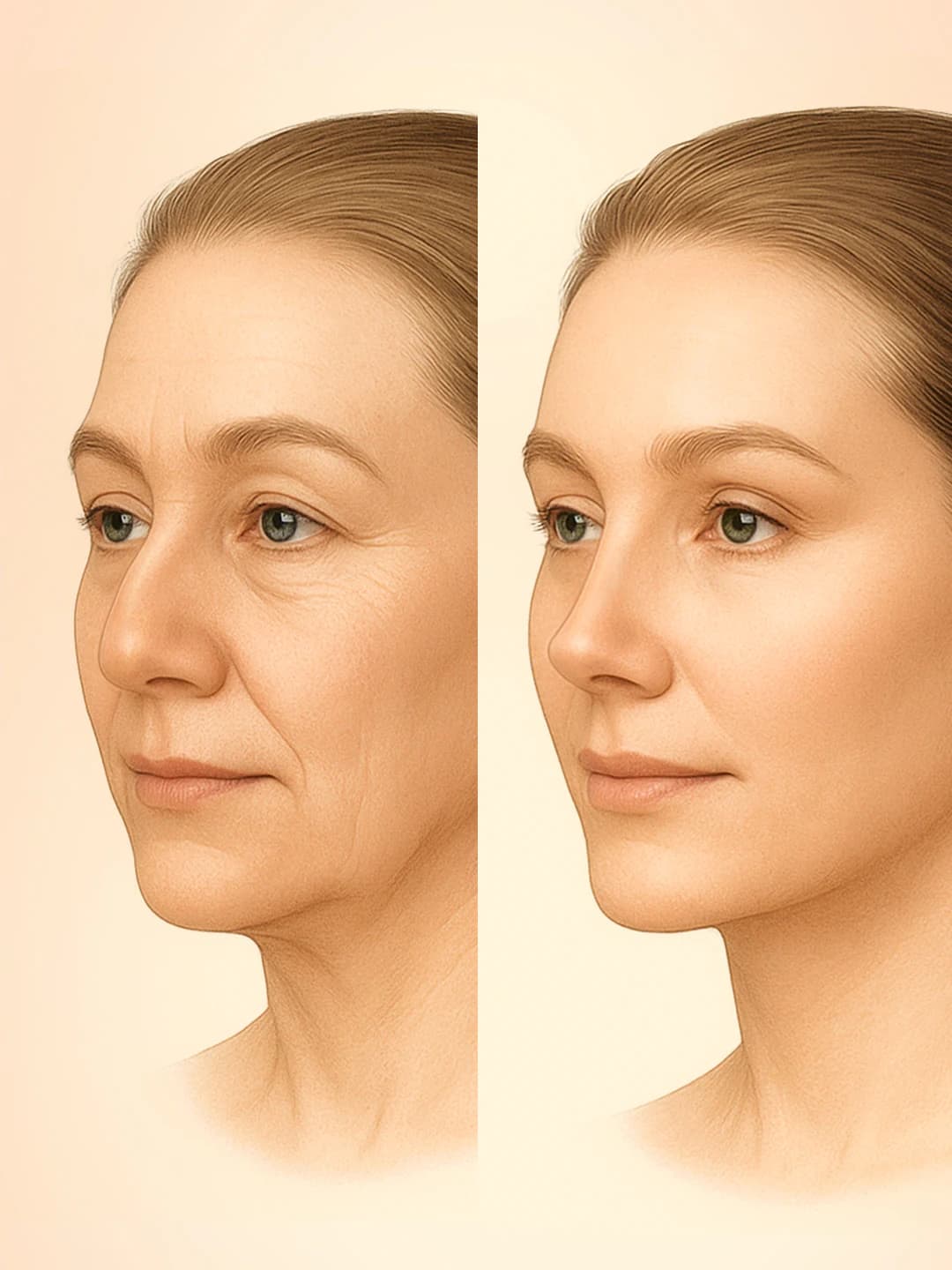
Do I need a midface lift or a full facelift?
It depends on which part of your face has changed. A midface lift treats the area between the lower eyelid and the corner of the mouth — flattened cheeks, hollowing under the eye, a deepening fold beside the nose. A full facelift treats the lower third — jowls, a softening jawline, loose skin in the neck. They address different zones, so the question is not which procedure is better but which pattern you actually have.
A quick self-check
What actually changes with age
Facial ageing is less about skin becoming loose than about deep tissue descending. The cheek fat pad sits high over the cheekbone in youth; over time its supporting ligaments weaken and it slides downward and inward. That single movement produces several things people notice separately: the cheek flattens, a hollow appears beneath the eye, the fold beside the nose deepens, and volume accumulates just above the jawline.
Recognising these as one process rather than four problems is what determines the right operation. Filling the hollow and filling the fold treats two symptoms of a descent that has not been corrected.
The midface lift
The Teo Midface Lift repositions the cheek fat pad upward, along a vertical vector — the direction the tissue actually fell from. This matters: lifting laterally, toward the ear, is what produces the swept, visibly operated appearance people associate with older facelift techniques. Lifting vertically restores the original position instead.
Because it works on deep structures rather than pulling skin, the result tends to age gracefully. It is well suited to patients in their forties and fifties whose cheeks have flattened but whose jawline is still defined.
The full facelift
A full facelift addresses the lower third: jowls, the jawline, and the neck. Modern technique repositions the SMAS — the fibrous layer beneath the skin that carries the facial muscles — rather than relying on skin tension. This is what keeps the result natural, since skin pulled tight without deep support both looks tight and relaxes again relatively quickly.
When the answer is both
Patients in their late fifties and beyond frequently show both patterns. Treating only one produces a face that is inconsistent with itself — a lifted jawline beneath a flattened midface reads as odd even when the observer cannot say why.
Combining them is a single operation and a single recovery, and it allows the surgeon to balance the two zones against each other rather than against a photograph.
What a consultation should establish
- Which zones show change, and how much of each
- Whether the change is descent, volume loss, or skin laxity — the treatment differs
- Skin quality and elasticity
- Your medical history, smoking status and healing profile
- What you actually want to look like, in your words
Final takeaway
Do not start from a procedure name. Start from which part of your face has changed, and let the operation follow from that. A midface lift and a facelift are not competing options at different price points — they treat different anatomy, and the useful question is which anatomy is yours.
Teo Midface Lift
Targeted rejuvenation of the mid-face region.
Frequently Asked Questions
What is the difference between a midface lift and a full facelift?
- A midface lift repositions the cheek fat pad and treats the area between the lower eyelid and the corner of the mouth. A full facelift addresses the lower third — jawline, jowls and neck. They treat different zones, so one cannot substitute for the other.
Which one do I need if my cheeks look flat but my jawline is fine?
- That pattern points to a midface lift. Flattening of the cheek with a visible hollow under the eye is midface descent, and lifting the lower face will not correct it.
Am I too young for a facelift?
- Age is a poor guide. Midface descent often begins in the late thirties or forties, well before jowling appears, and a midface lift at that stage is a smaller operation than waiting until the whole face has changed. What matters is the pattern of ageing, not the number.
Will fillers achieve the same result as a midface lift?
- No. Fillers add volume where tissue has descended; they do not reposition it. Used repeatedly over years they can make the face heavier without restoring its shape. A midface lift moves the descended fat pad back to where it originated.
Can a midface lift and a facelift be done at the same time?
- Yes, and for patients showing both patterns this is usually the better plan. One anaesthetic, one recovery, and a result that is balanced across the whole face rather than corrected in one zone.
Related Treatments
Teo Midface Lift
Targeted rejuvenation of the mid-face region.