Facelift Recovery Week by Week: Istanbul Guide
A realistic facelift recovery timeline for Istanbul patients, covering swelling, scar care, return to social life, and long-term result maturation.
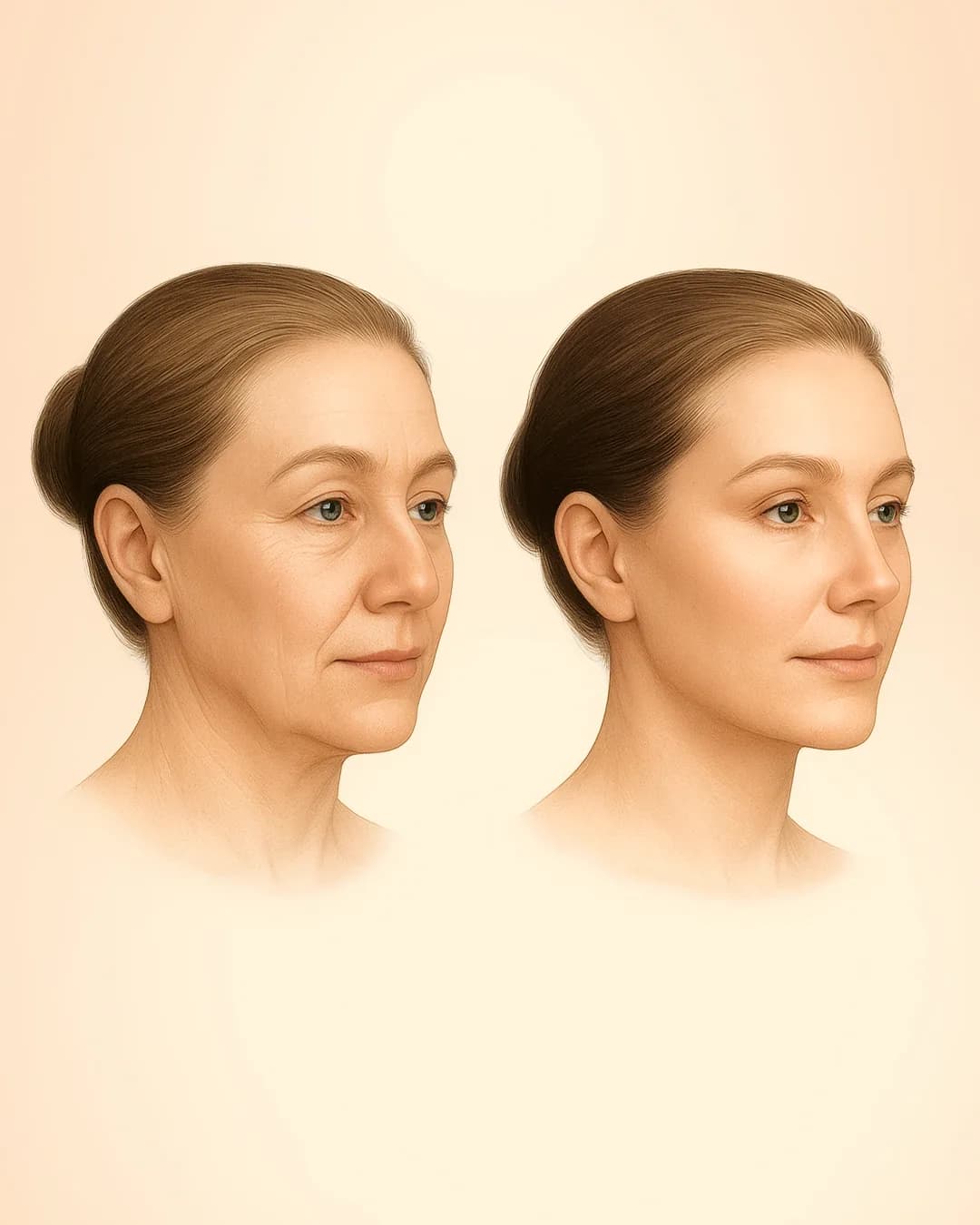
How long is facelift recovery?
Compression bandaging stays on for the first three days and comes off between days four and seven. Most patients are back to work and social engagements at weeks one to two. Residual swelling resolves through months one to three, and the final result is apparent at three to six months.
Patients usually ask when they will "look normal." The more useful question is how healing moves through stages, because that is what lets you plan travel, work and the events you care about.
The first night is spent in hospital
Days 1–3: bandaging and elevation
Rest with your head elevated. Compression bandaging supports healing through this phase, and mild to moderate swelling and bruising are expected.
Temporary asymmetry can appear as tissues respond, and it is one of the most common sources of early anxiety. Swelling almost never resolves at the same rate on both sides. At three days, you are not looking at your result — you are looking at the swelling.
Days 4–7: the bandaging comes off
Bandaging is removed and both swelling and bruising begin to improve significantly. Light activities can resume. This is usually the point at which patients feel the recovery has turned a corner, because the visible change from one day to the next is at its most obvious.
Early scar care begins in this window, following the specific instructions given for your incisions.
Weeks 1–2: back to normal life
Most patients feel comfortable returning to work and social engagements. Bruising that remains can be concealed with makeup once approved.
Concerns about looking overcorrected typically settle during this period, for a straightforward reason: much of what reads as "too tight" at week one is swelling, not surgery. As it resolves, the contour softens.
Months 1–3: contour emerges
Residual swelling continues to resolve and the rejuvenated contour of the cheeks and midface becomes increasingly defined. Natural facial movement improves as deeper tissue settles.
This is the least eventful phase and the one patients find hardest, because progress becomes slow enough to be invisible day to day. Comparing against a photograph from week one is more informative than looking in the mirror.
Months 3–6: the result matures
Final results are apparent. The face appears naturally refreshed with restored volume and smoother contours, and the result integrates with your own expression rather than sitting on top of it.
The milestones at a glance
| When | What to expect |
|---|---|
| Days 1–3 | Compression bandaging; rest with head elevated; swelling and bruising |
| Days 4–7 | Bandaging removed; swelling and bruising improve markedly; light activity |
| Weeks 1–2 | Return to work and social engagements; makeup over residual bruising |
| Months 1–3 | Residual swelling resolves; midface contour defines |
| Months 3–6 | Final result; naturally refreshed appearance |
Scar care is where discipline pays
Incisions are placed in the hairline and in natural creases, which gives them every chance of disappearing — but placement only sets the ceiling. Aftercare determines whether you reach it:
- Follow wound care exactly as instructed, not approximately.
- Protect the incision areas from UV exposure. Sun on an immature scar is the most common cause of a visible one.
- Avoid aggressive massage unless it has been specifically recommended for you.
What slows facelift recovery down
Most of the variance between two patients with the same operation comes from the same short list:
- Sleeping flat. Elevation in the early phase measurably reduces overnight swelling, and the effect compounds across the first weeks.
- Nicotine. It impairs tissue perfusion at precisely the point healing depends on it. This is the single most consequential item on the list.
- Returning to exertion early. Raising blood pressure before the tissue has settled is the mechanism behind bleeding under the flap.
- Sun on immature scars. The most common cause of a scar that stays visible rather than fading.
- Judging the result at week two. Much of what reads as tight or asymmetric early is swelling, and swelling resolves unevenly.
None of these require effort so much as patience. The operation is finished on day one; the result is not finished for months.
Travel and international follow-up
Confirm your follow-up schedule before departure, including photo check-ins and clear criteria for when to make urgent contact. Knowing exactly who to message, and what counts as worth messaging about, matters more once you are in a different time zone.
Clearance to fly comes later after a facelift than after nasal surgery — when it is safe to fly home covers what the assessment involves. If you are still deciding between procedures, facelift vs midface lift addresses which one your anatomy actually calls for.
Final takeaway
Facelift recovery is front-loaded: bandaging for three days, off by day seven, back to normal life at one to two weeks, then a long quiet phase where the result matures through to six months. The surgery sets the ceiling and the first six weeks determine whether you reach it — elevation, exact wound care, sun protection and patience are what turn a good surgical result into a great one.
Teo Midface Lift
Targeted rejuvenation of the mid-face region.
Frequently Asked Questions
When can I go back to work after a facelift?
- Most patients feel comfortable returning to work and social engagements at weeks one to two, once the bandaging is off and bruising can be concealed with makeup. Roles involving heavy lifting or physical exertion need longer. Plan for a little more time than you expect to need and treat an earlier return as a bonus.
When will I stop looking swollen after a facelift?
- Swelling and bruising improve significantly once the bandaging comes off at days four to seven. Residual swelling continues resolving through months one to three, and final results are apparent at three to six months. It is that last quiet phase that makes a result look natural rather than done.
Do I stay in hospital after a midface lift?
- Yes, one night. The Teo Midface Lift is performed under general anaesthesia at the American Hospital in Istanbul, takes two to three hours, and involves an overnight stay for post-operative monitoring and comfort during the first hours of recovery.
Is facial asymmetry normal in the first weeks after a facelift?
- Yes. Swelling rarely resolves at the same rate on both sides, so temporary asymmetry in the first weeks is expected and not a sign that anything has gone wrong. Persistent asymmetry beyond three months should be raised at follow-up.
How do I look after facelift scars?
- Follow the wound-care instructions exactly, keep the incisions out of direct sun, and avoid aggressive massage unless your surgeon has specifically prescribed it. Incisions are placed in the hairline and natural creases, so disciplined aftercare is usually the difference between a hidden scar and a visible one.
Related Treatments
Teo Midface Lift
Targeted rejuvenation of the mid-face region.