
How to Read Rhinoplasty Before and After Photos
How lighting, angle and timing distort rhinoplasty results photos, what a trustworthy gallery looks like, and the checks that expose a misleading one.
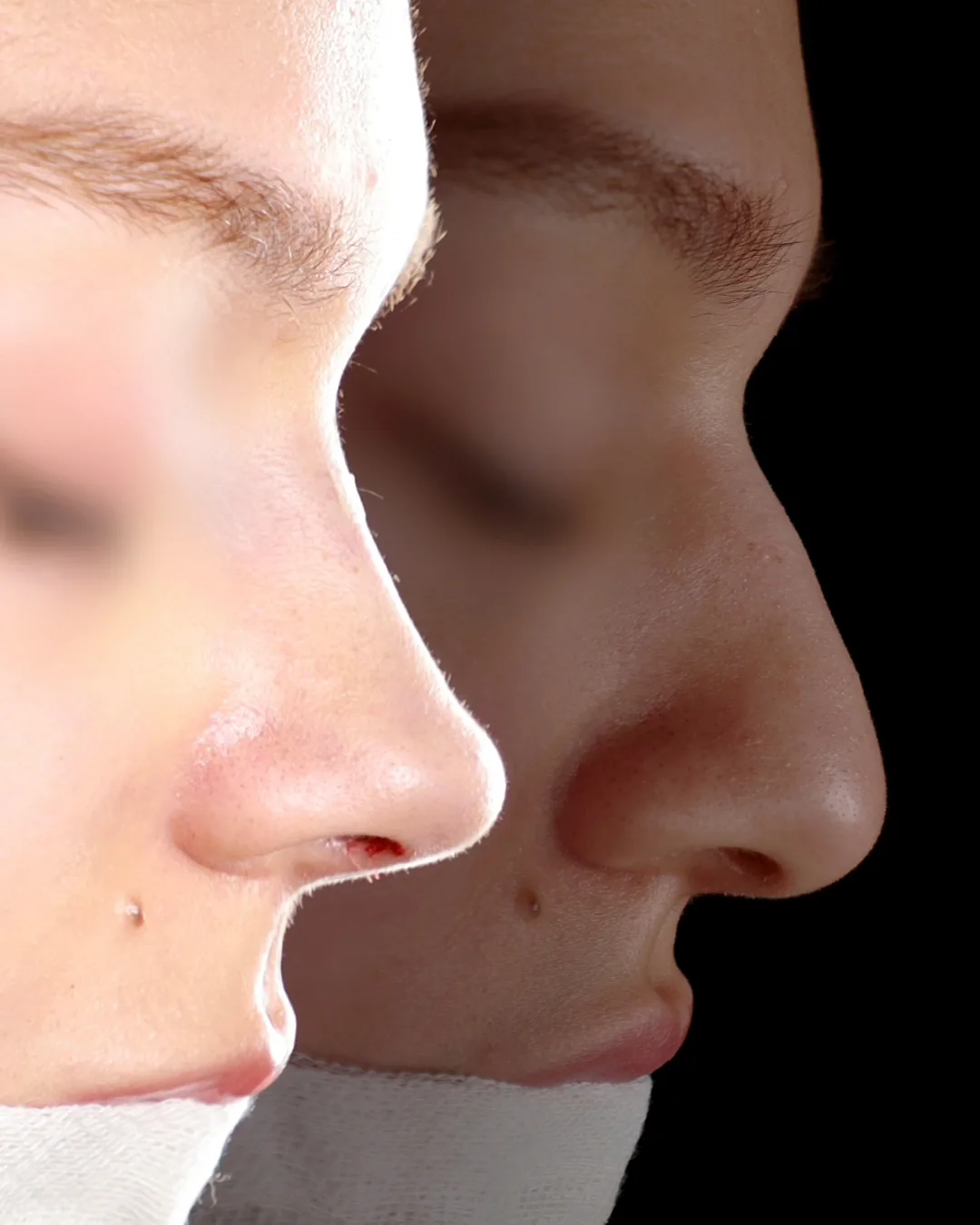
How do I read rhinoplasty before and after photos properly?
Compare everything except the nose first. If the lighting, camera distance, head angle, hairstyle or make-up differ between the two frames, the apparent improvement includes changes that have nothing to do with surgery. A trustworthy comparison holds every variable constant and changes only the anatomy — and states how long after surgery the second photo was taken.
Results galleries are the most persuasive thing on any surgeon's website and the easiest thing to manipulate without editing a single pixel.
The thirty-second test
The variables that distort a comparison
Lighting. The most powerful and least noticed. Harsh overhead light casts a shadow that exaggerates a dorsal hump; soft frontal light flattens it. Shooting the before under unflattering light and the after under flattering light produces a dramatic improvement with no surgery at all.
Head position. A few degrees of chin elevation shortens the appearance of the nose and rotates the tip upward in the frame. A slight downward tilt lengthens it. In a genuine comparison the Frankfort horizontal plane — roughly, the line from the ear canal to the bottom of the eye socket — is level in both images.
Camera distance and focal length. Close-up shots with a wide lens enlarge the nose relative to the face; longer lenses compress it. A before photo taken on a phone at arm's length and an after taken on a proper lens at standard distance are not comparable.
Make-up and grooming. Contouring alone can visibly reshape a nose. A bare-faced before and a made-up after is a cosmetics demonstration, not a surgical one.
Expression. Smiling depresses the tip and widens the base in many people. A neutral expression in both frames is standard.
Timing. An after photo at six weeks shows a nose still substantially swollen, particularly at the tip, which will continue to refine for months. Depending on which way the swelling falls, an early photo can flatter or misrepresent the eventual result. The swelling timeline explains why twelve months is the meaningful interval.
What a trustworthy gallery looks like
- Standardised photography. Same background, same lighting setup, same distance, same head position throughout.
- Multiple angles per patient. Frontal, both profiles, both three-quarter views, and ideally a base view. A nose corrected on one view can be visibly uncorrected on another.
- Stated intervals. "Twelve months post-operative" tells you what you are looking at. An unlabelled after photo does not.
- A range of starting points. Thick skin and thin, straightforward humps and asymmetric bases, primary and revision. A gallery of exclusively easy cases has been curated for effect.
- Believable outcomes. Noses that suit the faces they are on. A gallery where every result converges on the same small, upturned nose shows a surgeon applying a template rather than planning for each face.
What to look for in the result itself
Once you trust the comparison, look at the outcome:
- The dorsal line on profile. Straight, or gently curved to suit the patient's sex and face. Not scooped, and not leaving a residual fullness above the tip.
- Tip definition versus tip pinching. Refinement should look like structure, not like the tip has been squeezed. Pinching often signals over-resection that will worsen as scar tissue contracts.
- The base on frontal view. Proportionate to the face rather than narrowed to a fixed ideal. Excessive narrowing frequently costs airway function.
- Whether it still looks like the same person. A good rhinoplasty removes the feature that drew attention and leaves the face recognisable. If you cannot tell it is the same patient, that is a warning rather than a triumph.
- Consistency with your own anatomy. A brilliant result on thin skin tells you little about what is achievable on thick skin. Look for the patient whose starting nose most resembles yours.
Why some clinics publish no photographs
The absence of a gallery is not itself a red flag. Several jurisdictions restrict before-and-after imagery in healthcare advertising, and some surgeons choose not to publish patient photographs even where permitted, on privacy grounds. Where photographs are published, they should be with the explicit consent of the patient shown.
In either case, asking to review results privately during a consultation is a normal and reasonable request. What should concern you is a clinic that neither publishes results nor will show you any — or one that shows you images it cannot confirm are its own work.
Questions to ask about a gallery
- How long after surgery were these photographs taken?
- Were these operations performed by the surgeon I would see?
- Can I see a patient whose starting anatomy resembles mine?
- Can I see a case that did not go as planned, and what was done about it?
The last question is the most revealing. Every surgeon has cases that needed revision. One who will discuss them is more credible than one whose record appears flawless — a point that runs through the whole surgeon selection checklist, and which matters even more when comparing clinics across countries.
Final takeaway
Treat a results gallery as evidence to be examined rather than a portfolio to be admired. Check that the two frames differ only in anatomy, that the interval is stated and long enough to be meaningful, and that multiple angles are shown. Then find the patient who started closest to where you are, because that is the only case in the gallery that predicts anything about your own result.
Teorhinoplasty
Dr. Dogan's signature rhinoplasty technique -- no cast, no tampons.
Frequently Asked Questions
How can I tell if before and after photos have been manipulated?
- Compare the elements that have nothing to do with the nose. If lighting, camera distance, head tilt, hairstyle or make-up change between the two frames, the comparison is unreliable even if no editing occurred. Consistent background, consistent lighting and an identical head position are the marks of a gallery worth trusting.
How long after surgery should an after photo be taken?
- At least twelve months for a meaningful result, since the tip continues refining for a full year. Photos taken at six weeks show a swollen nose that will still change substantially. A gallery that labels the interval is being straightforward; one that does not is asking you to assume.
Why do surgeons show the same few angles?
- Standard rhinoplasty photography uses frontal, both profiles, both three-quarter views and a base view, because a nose can look corrected from one angle and uncorrected from another. A gallery showing only the most flattering profile is selecting for the angle that works, which is precisely what you need to look past.
Should I judge a surgeon by their best results?
- No — judge them by their typical ones, and by results on a nose like yours. Any surgeon can produce a striking outcome on an ideal candidate with thin skin and a straightforward hump. What tells you more is how they handle thick skin, an asymmetric base, or a revision case.
Is it a problem if a clinic shows no patient photos at all?
- Not necessarily. Some jurisdictions restrict before-and-after advertising in healthcare, and some surgeons decline to publish photographs on privacy grounds. In that case ask to view results during a private consultation, which is a normal request and one an established practice will accommodate.